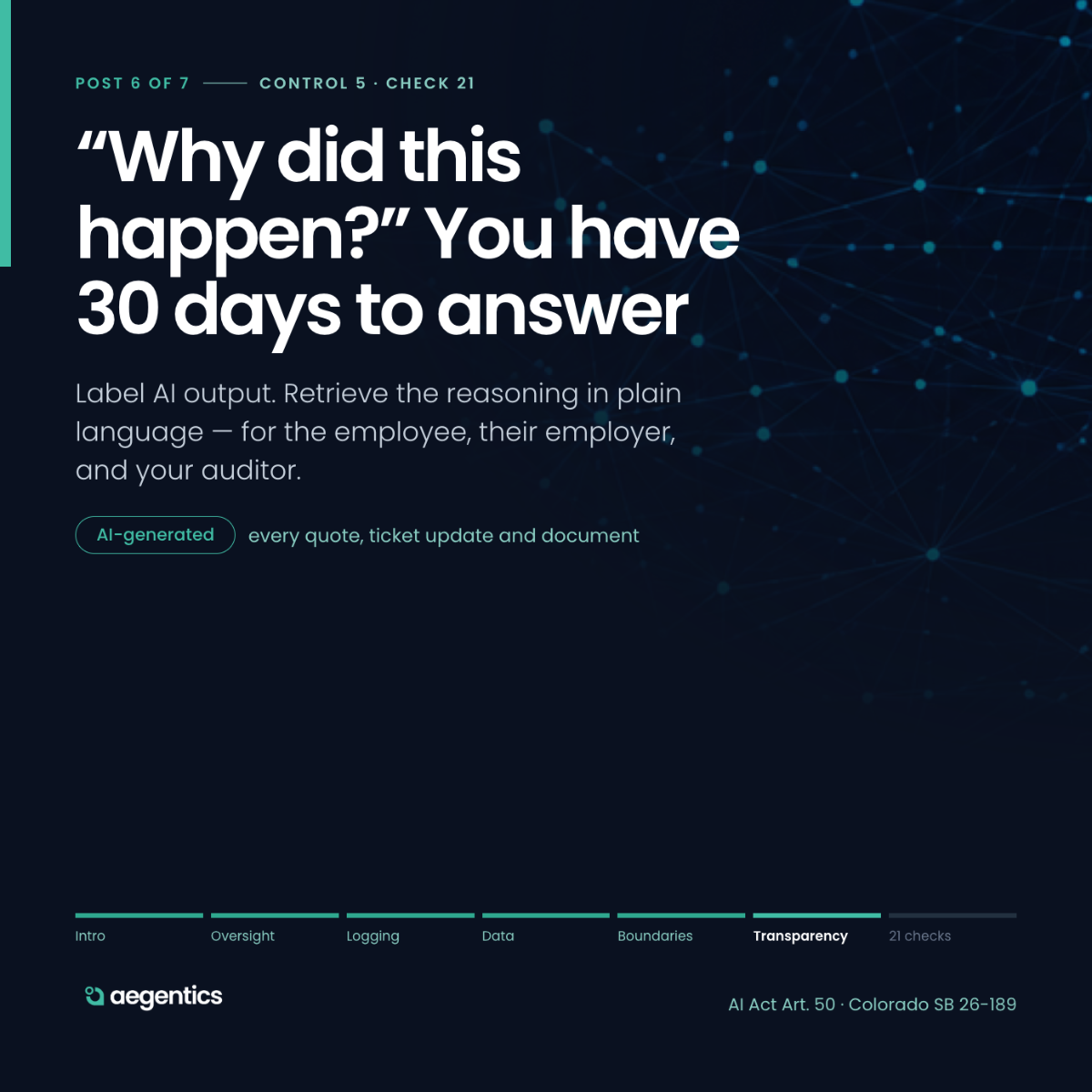
For MSPs this creates a practical problem: when an AI agent changes an employee’s access rights, resets a password, or updates a ticket, the affected person, their employer, and your auditor may all ask the same question - why did this happen? - and they expect an answer that is understandable, timely, and backed by evidence.
This is Post 6 in our 7-part series based on The AI Governance Checklist for MSPs. After covering the overall need for the checklist (Post 1), human oversight (Control 1), logging & traceability (Control 2), data protection (Control 3), and technical control boundaries (Control 4), we now examine Control 5: Transparency and Accountability: the requirements that turn internal decision trails into external explanations.
Why Transparency Is Already Enforceable
Unlike some high-risk obligations that are still phasing in, transparency duties are live or imminent across major jurisdictions. The right to an explanation is only answerable if the full decision trail was captured in the first place (see Control 2). Without structured logging and attributable records, you cannot produce the explanation the law requires.
Here is the core requirement that forms Control 5, plus two important bonuses that strengthen accountability:
21. The system identifies itself as AI, labels AI-generated output, and can explain its decisions.
End users must know they are interacting with an AI. Quotes, ticket updates, and documents generated by the system must be marked as AI-generated. When a decision affects a person, the reasoning behind it must be retrievable in understandable form - by the affected employee, their employer, and your auditor.
Bonus 1: Compliance frameworks shape agent behavior per customer.
Your healthcare customer runs HIPAA or NEN 7510; your manufacturing customer runs ISO 27001 Annex A.9; your smallest customer runs nothing. The platform should let you activate frameworks per end-customer, so the agent reasons with the corresponding rigor: more procedural steps, more documentation, and stricter approval defaults for regulated customers.
Bonus 2: The vendor’s own conformance is publicly verifiable.
A vendor confident in its governance architecture publishes its control mapping: pre-execution interception, step-up authorization, tamper-evident receipts, identity binding; where prospects and auditors can validate it independently. A compliance whitepaper available only under NDA sends a different signal.
What Strong Transparency Looks Like in Practice
An employee receives a ticket update that their access rights have changed. The update is clearly labeled as AI-generated. When they (or their manager, or an auditor) ask for the reason, the MSP can retrieve:
- The original ticket and goal
- The evidence the agent gathered
- The parameters it extracted
- The agent memory that was used, at the time it was used
- The confidence score
- The human approvals (if any) and the context those approvers saw
- The exact action taken and the credential scope used
All of this is presented in plain language, not as raw log entries. The same record satisfies an internal review, a customer inquiry, and a formal 30-day explanation deadline under Colorado-style rules.
Practical Tip for MSPs: Test the explanation capability during vendor evaluation. Simulate an adverse outcome (for example, an access change that is later questioned) and ask the vendor to produce the explanation package that would be handed to the affected individual and to an auditor. Time how long it takes and assess whether a non-technical person could understand it.
How to Evaluate Vendors on Transparency and Accountability (Control 5)
Ask these questions of any AI agent platform:
1. How does the system identify itself as AI to end users, and how is AI-generated content labeled in tickets, quotes, and documents?
2. When an affected employee asks why the AI changed their access rights, what exactly can I hand them out, and would it satisfy a 30-day explanation deadline?
3. Can I activate different compliance frameworks (HIPAA, ISO 27001, etc.) per end-customer, so the agent adjusts its rigor automatically?
4. Is your control mapping (pre-execution interception, authorization, tamper-evident receipts, identity binding) published and independently verifiable, or available only under NDA?
Vendors who can demonstrate clear labeling, retrievable plain-language explanations, and per-customer framework activation show they have built transparency into the product. Those who rely on generic statements about “transparency features” do not.
Regulatory Mapping for Control 5
This control directly addresses:
- EU: AI Act Articles 4, 50, and 86; GDPR Article 22(3)
- US: Utah AI disclosure law, California AI Transparency Act, Colorado SB 26-189 pre-use notices and adverse-outcome explanations
- APAC: Korea AI Basic Act user notification duties (with administrative fines for failure to notify), Japan AI Guidelines for Business
A platform that labels AI output, provides understandable explanations backed by the decision trail, and supports per-customer compliance frameworks satisfies the strictest of these rules and therefore the rest.
Conclusion & Takeaways
Transparency is no longer optional marketing language. It is a live regulatory duty in multiple jurisdictions and a practical necessity for MSPs who must answer customers and auditors. When the system clearly identifies itself, labels its output, and can reconstruct the reasoning behind any decision that affects a person, you turn a potential liability into a demonstrable control. And as a bonus, it will provide you peace of mind as a business owner.
Key Action Items:
1. Map your current or prospective AI platform against Control 5 (Check 21 plus the two bonuses).
2. Confirm that AI-generated content is automatically labeled and that explanations can be produced in understandable form.
3. Verify that different compliance frameworks can be activated per end customer.
4. Prefer vendors whose own governance architecture is publicly verifiable
rather than locked behind NDAs.