Regulators are clear on this point. The EU AI Act requires automatic
logging throughout the system’s lifecycle. Texas TRAIGA turns substantial,
documented alignment with the NIST AI Risk Management Framework into an
affirmative defense, but only if the documentation is robust enough to survive
discovery. SOC 2, HIPAA, and Korea’s AI Basic Act all demand the same core
quality: tamper-evident records.
Most vendors claim “comprehensive audit logs.” Few deliver logs that cannot be quietly altered by a database administrator. This is the gap that turns a compliance talking point into a real risk for MSPs.
This is Post 3 in our 7-part series based on The AI Governance Checklist for MSPs. After covering the need for the checklist (Post 1) and Human Oversight (Post 2), we now examine Control 2: Logging and Traceability — the five checks that turn activity into defensible evidence.
Why Logging Is Legal Armor for MSPs
As an MSP you already carry accountability for every change your technicians make. AI agents amplify both the speed of those changes and the volume of evidence required. When a customer’s auditor, a regulator, or a court asks “what exactly happened?”, a log that can be edited is not evidence. A log that is incomplete is a finding.
The operative word across every major regime is tamper-evident. A cryptographically chained, automatically generated, fully attributable record satisfies Brussels, Austin, Seoul, and Singapore with the same mechanism.
Here are the five specific requirements every MSP should verify:
(Read about check 1-6 in last week’s post: Control 1; Human Oversight)
7. Every action, decision, and approval is logged automatically, without exception.
This includes actions that were blocked, approvals that were rejected, and the credentials that were used. Gaps in the record become findings in an audit and holes in any safe-harbor defense. Logging must be continuous and non-optional.
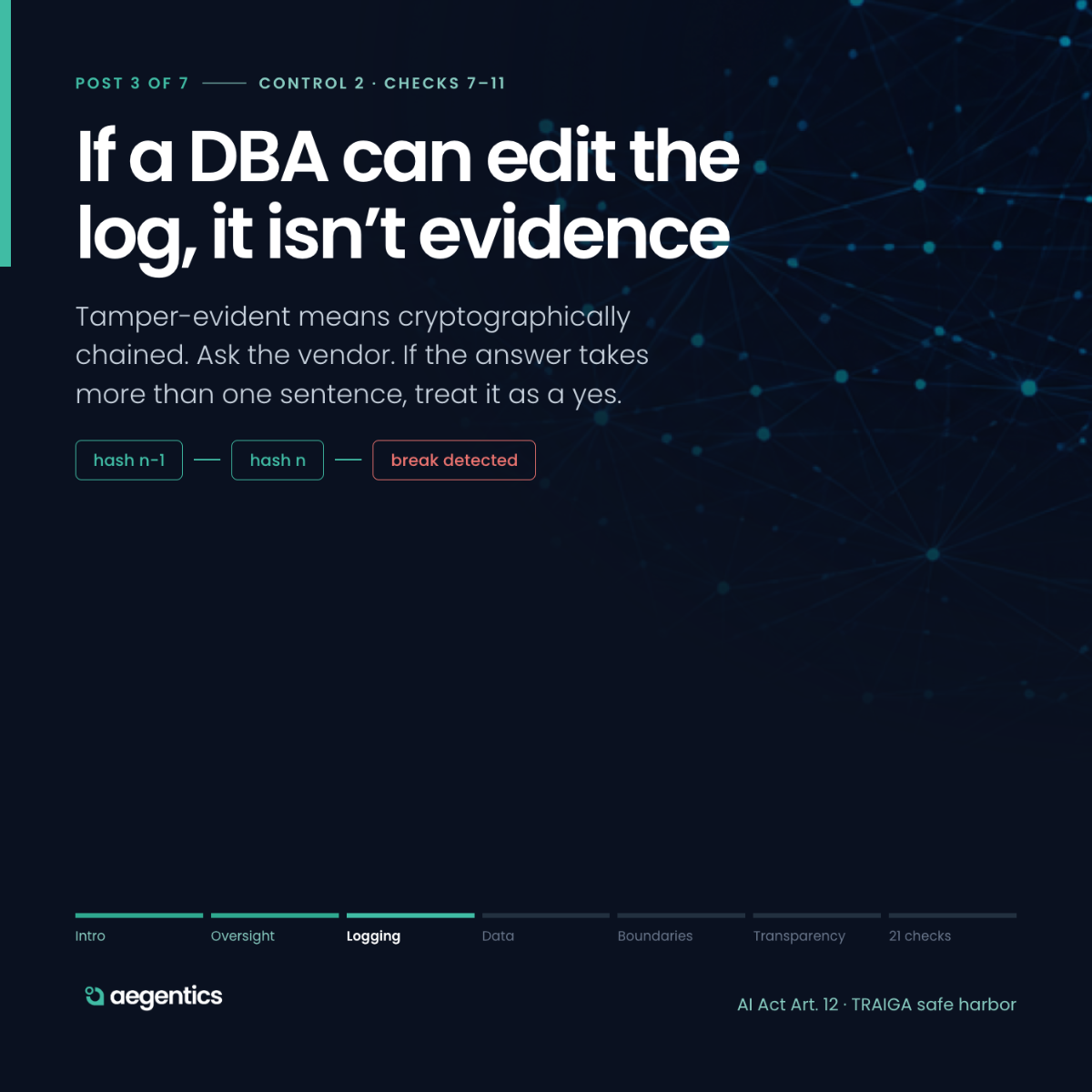
8. The audit log is cryptographically chained.
Each entry carries a hash of the previous entry. Any modification breaks the chain and is detectable. Ask the vendor directly: “Can a database administrator alter a log entry without detection?” If the answer takes more than one sentence, treat it as a yes.
9. Compliance evidence is separated from operational telemetry, with retention you control.
A SOC 2 or HIPAA customer may need seven years of evidence; a smaller commercial customer may need only ninety days. If compliance events and debug telemetry live in one undifferentiated stream, retention policy becomes a gamble. Separation lets you set appropriate retention independently.
10. Audit events export to your SIEM in an open schema.
Governance data locked inside a vendor dashboard is governance you cannot correlate. Events should arrive in Splunk, Microsoft Sentinel, or equivalent tools in a standard format such as OCSF — without custom parsers — carrying agent identity, credential scope, decision outcome, and hash-chain reference.
11. Every action is attributable end-to-end.
Which agent, under which credential scope, authorized by which decision, approved by which human, against which ticket. If any link in that chain is missing, reconstruction after an incident becomes impossible.
What Strong Logging Looks Like in an MSP Environment
Consider a multi-step ticket: “Create a new user, assign an M365 license, and add to a security group.”
A properly governed platform will automatically log:
- The agent’s classification and confidence score
- Every parameter extracted
- Each approval request, the named approver, the decision (approve/reject), and the context shown
- The exact credential scope minted for each action
- Successful or blocked execution of every step
- The cryptographic hash chain linking all of the above
Months later, when a customer asks why a license was assigned or an auditor requests the decision trail, you can produce a complete, verifiable record rather than reconstructing events from ticket notes and vendor screenshots.
Practical Tip: During vendor evaluation, request a sample export of a multi-step
action log and attempt to validate the steps.