Paper policies and vague “human-in-the-loop” promises no longer cut it. The EU AI Act demands real-time intervention capability. Colorado’s incoming law grants individuals a right to meaningful human review of adverse outcomes. Korea’s AI Basic Act imposes heightened duties for high-impact systems. And the NIST AI RMF (which serves as an affirmative defense under Texas TRAIGA) emphasizes structured governance and accountability.
For MSPs, this isn’t theoretical. Your technicians already operate under strict approval processes. Your AI agents must do the same, but better, with clearer evidence.
This is the second post in our 7-part series based on The AI Governance Checklist for MSPs. In Post 1 we covered why this checklist exists. Here we dive deep into Section 01: Human Oversight — the first and most critical control area.
Why “Theoretical” Oversight Fails Regulators and Auditors
Every major framework rejects the same flawed approach: “A human could theoretically intervene.”
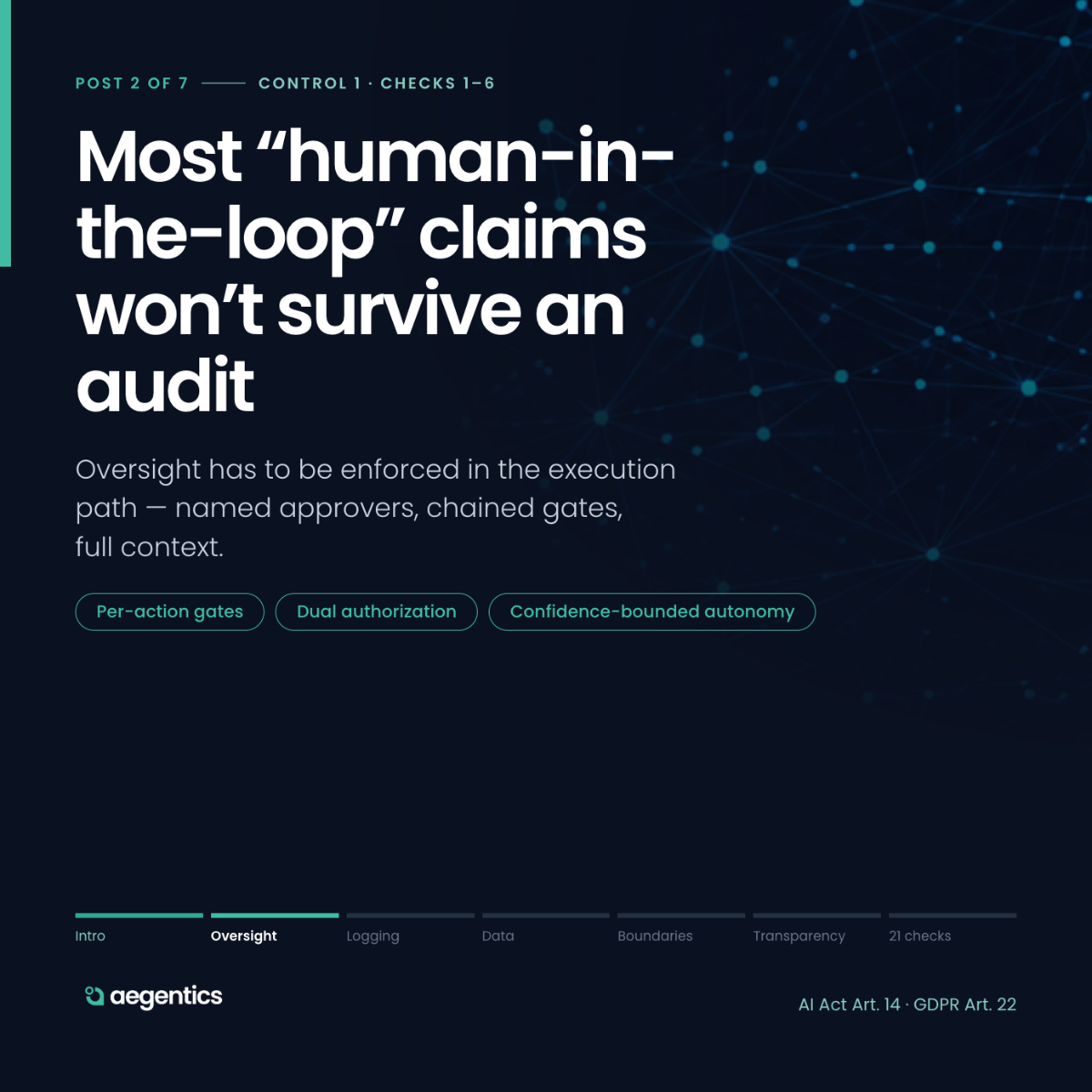
Oversight must be structurally enforced in the execution path. That means approval gates baked into the workflow, not optional toggles or after-the-fact reviews.
Here are the six specific requirements MSPs should verify before letting any AI agent touch a customer environment:
1. Approval gates are enforced per action type, not as a global on/off switch.
A password reset and granting global admin rights carry vastly different risks. Your platform must let you configure granular policies: autonomous execution for low-risk actions, mandatory approval for high-risk ones; per customer, per action type.
2. Approvers are named individuals resolved through an authorization matrix.
When an auditor asks “Who approved this change?”, “The team” is not an acceptable answer. Approval rights must map to specific people and roles, ideally synced with your PSA system so accountability is always traceable to a real person.
3. Dual authorization is supported: your engineer/MSP side and the customer’s contact.
Many actions require sign-off from both sides of the relationship. A platform that only understands one approval hierarchy cannot accurately model how MSPs actually deliver services.
4. Multi-step actions produce chained approvals with sequential gating.
Creating a user with an M365 license involves both identity and financial decisions. Each step needs its own guardrails. Execution must wait for the full chain to complete successfully. If any step is rejected, the entire process will be canceled.
5. The approver sees full context, not just a proposed action.
Approvers must see: the goal, evidence gathered by the agent, extracted parameters, potential financial impact, confidence score, and rollback path. Approving blind isn’t oversight; it’s simply shifting liability to your technician.
6. Autonomy is bounded by confidence, not just configuration.
Even if policy allows autonomous execution for a given action, the system should downgrade to human review if the agent’s confidence in its classification or parameters is low. Effective authority should be the minimum of policy permission and model confidence.
What This Looks Like in Practice for MSPs
Imagine a ticket comes in: “Reset password for John Smith and grant Teams access.”
- The agent classifies the request, extracts parameters, and determines the required permissions.
- For the password reset: low risk → potentially autonomous (subject to confidence).
- For the Teams license addition: higher risk → requires named approver review with full context.
- If dual approval is configured for this customer, both your team and the customer’s IT contact must sign off before execution proceeds.
- Every decision and approval is logged with full attribution.
This granular, context-aware approach satisfies auditors while preserving the speed MSPs need.
Pro Tip for MSPs: Start by categorizing your top 20 most common agent actions by risk level. Use that as the foundation for your initial approval matrix. Review and refine periodically as you gain experience with the platform.
How to Evaluate Vendors on Human Oversight
When speaking with AI agent vendors, ask:
- Can you show me exactly how per-action approval gates are configured in the UI?
- How does the system handle multi-step actions with different approvers?
- Walk me through what an approver sees before signing off.
- What happens if the agent’s confidence score drops below threshold on an “autonomous” action?
- Does the platform support dual (MSP + end-customer) authorization workflows?
Vendors who answer with concrete mechanisms and demonstrations earn
confidence. Vague assurances about “enterprise-grade oversight” earn
skepticism.
The Regulatory Convergence
The AI Governance Checklist – Control 2 directly maps to:
- EU: AI Act Article 14 + GDPR Article 22
- US: NIST AI RMF Govern & Manage functions, Colorado SB 26-189 human review rights, FINRA guidance
- APAC: Korea AI Basic Act high-impact AI duties, Singapore Model AI Governance Framework (including agentic AI)
A platform built to the strictest of these requirements satisfies the others.
Conclusion & Takeaways
Strong human oversight is not a barrier to AI efficiency; it is what makes AI deployment defensible and scalable for MSPs. By enforcing granular, auditable controls in the execution path, you protect your business, your customers, and your reputation while unlocking the real value of autonomous agents.
Key Action Items:
1.Review your current (or prospective) AI platform against these six checks.
2.Map your most common service actions to approval requirements.
3.Document your oversight policy per compliance framework (HIPAA customers
vs. standard commercial, etc.).
In this 7-part series, we’ll dive into 21 actionable checks across 5 critical controls:
- Intro – AI Governance for MSPs
- Control 1 – Human Oversight
- Control 2 – Logging & Traceability
- Control 3 – Data Protection & Residency
- Control 4 – Technical Control Boundaries
- Control 5 – Transparency & Accountability
- Conclusion – 21 Checks + Compliance Control Map
Skip the Series, get your Compliance Control Map now:
Skip the Series, get your Compliance Control Map now: