Most writing about AI in IT support stays vague about people. Engineers will be "freed up for higher-value work" and nobody asks what that work is, who does it, or what happens to the people whose job was the lower-value work. MSP owners deserve a straighter answer, and so do their engineers.
Here it is. When agents handle the routine share of L1, you will hire far fewer people to do L1. Some L1 roles in their current form will not exist, and as autonomous coverage grows, L2 shrinks too. For most MSPs this will not mean redundancies, because they are already short of engineers and will use the capacity to grow without hiring. But the job changes, and the L2 job changes most of all.
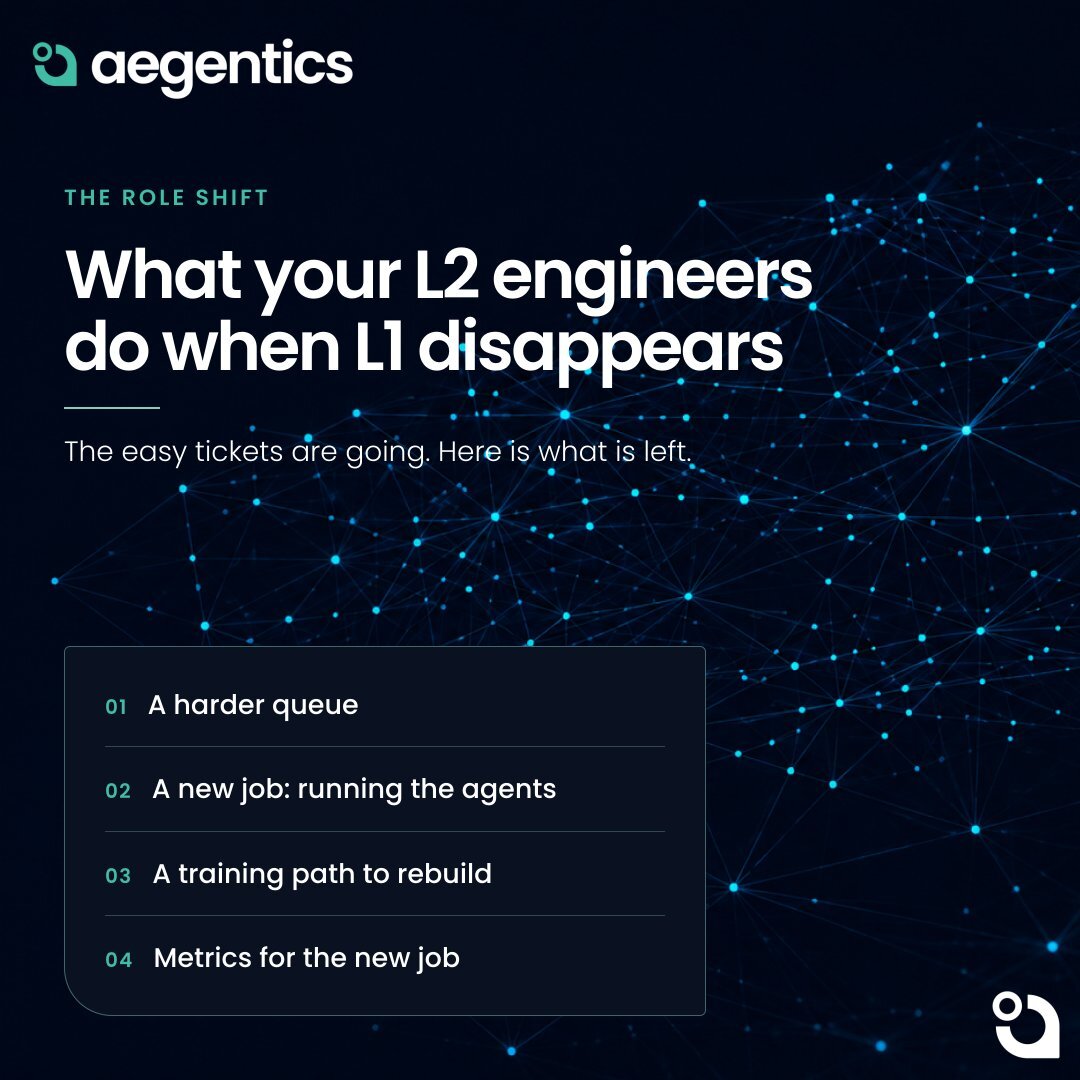
The queue gets harder
Today an L2 engineer's day is a mix. Some tickets are hard. Many are routine work that escalated because L1 was busy, unsure or new. The routine ones matter more than they look: they are where an engineer recovers between hard problems.
When agents resolve the routine work at the front door, what reaches L2 is the residue: the ambiguous, the novel, the multi-system, and the politically sensitive. The average difficulty of an L2 ticket goes up. So does cognitive load per hour. An MSP that keeps the same ticket targets for L2 after deploying agents will burn out its best engineers within a year.
The compensating change is that escalations arrive investigated. An agent that escalates has already triaged the ticket, checked the device, pulled the client history and recorded what it tried and why it stopped. L2 starts from a diagnosis rather than a blank ticket. That is a real gain, but it only helps if the time saved is spent on the problem and not on a higher quota.
A new job appears: running the agents
An autonomous agent does what it is allowed to do, with the context it has been given. Somebody has to decide both.
That somebody is your L2 and L3 team. They decide which ticket categories run autonomously and which stay supervised. They review escalations and ask why the agent stopped: missing access, missing documentation, a genuinely hard case, or a limit set too tight. They correct the agent when it is wrong, maintain the client knowledge it works from, and widen its scope where it has earned it.
This is the work industrialisation always creates. The machine does the production step, and skilled people own the machine's configuration, quality, and boundaries. It is closer to engineering than to support, and it is where most of the leverage now sits. An engineer who raises autonomous coverage on a ticket category by ten points has removed more work than a year of closing tickets.
The rest of the time moves up
The capacity released goes to work MSPs have always said they wanted to do and rarely had time for: proactive engineering, standardisation projects, security posture work, and technical conversations with clients about where their environment should go. Much of it also feeds back into autonomy, because a standardised, well-documented environment is one an agent can act in safely.
Not every engineer will want this job. Some are excellent at fixing things and have no interest in configuring systems that fix things. Say that out loud early, and decide together where each person fits, rather than letting people discover it through a changed queue.
The training pipeline breaks unless you rebuild it
Here is the problem few MSPs have thought through. L1 was the apprenticeship. People learned the stack by resetting passwords, fixing mailbox rules and chasing printer faults, and the good ones became L2. Remove that work and you remove the path.
The replacement has to be deliberate. Reviewing agent decisions is a strong training ground, because each one shows the reasoning, the evidence and the action side by side with the outcome. Juniors can handle supervised escalations with a senior on hand. What does not work is assuming future L2 engineers will appear the way they used to.
Measure the new job, not the old one
Tickets closed per engineer stops meaning anything when the easy tickets no longer reach engineers. Better measures: exceptions resolved, time from escalation to resolution, autonomous coverage gained per category, and repeat tickets eliminated at the root. If you pay and promote on the old metric, you will get the old behaviour.
The honest summary
Fewer people doing L1. L2 engineers
doing harder work, owning the agents that absorbed the easy work, and spending
the released time on engineering. A training path you have to design instead of
inherit. None of that is a euphemism, and none of it is a threat to a good
engineer. It does require an owner who plans for it rather than lets it happen.
This is part of a series of 7 blog posts about the industrialization of Managed Services.
1 - In the 4th and current Industrial Revolution, AI disrupts IT operations fast and MSPs must respond faster
2 - The half-finished industrialization.
Next week: Post 4: Automation as craft
Don't want to wait for the next blog? Binge the whole story, download our E-book: